The 73rd Venice Film Festival, La Biennale di Venezia: Women’s Voices in Independent Cutting-Edge Cinema
Review by Moira Sullivan
Developmental Editing by Alexandra Hidalgo
Copy Editing and Posting by Elena Cronick
The 73rd Venice Film Festival, La Biennale di Venezia, is one of my favorite film festivals because it features the latest in film art and innovation. Almost every film feels like an original work of art with captivating beauty. This is particularly true of the films that do not come from Hollywood studios complete with major stars as bonuses for the premieres, or films from other festivals that have already made the rounds.
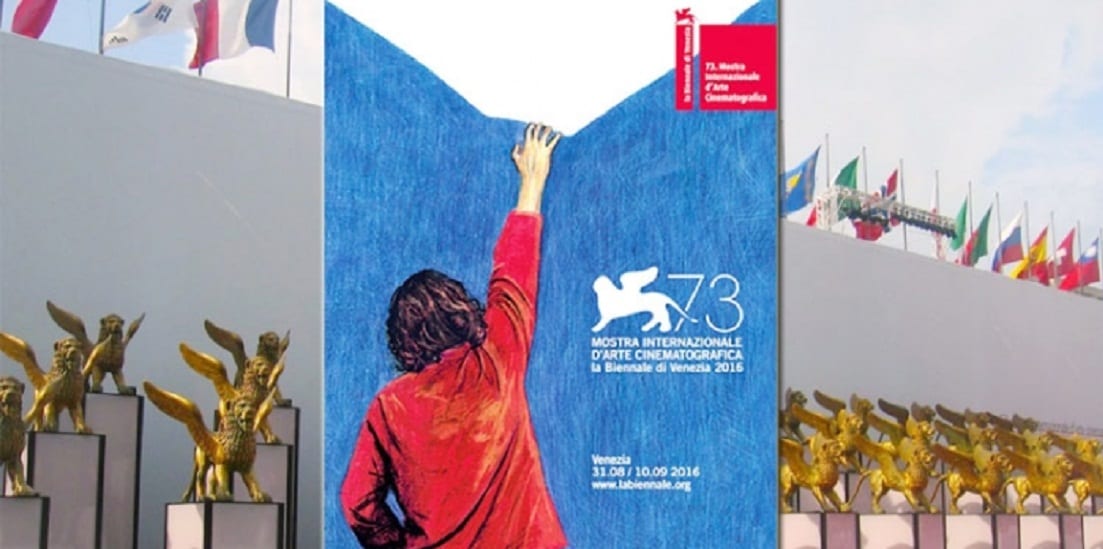
The 73rd Venice Film Festival. Courtesy of La Biennale di Venezia.
In the genesis of the filmmaking business in the 1920s, women were making, directing, and writing films in Hollywood. Today only a handful of women work in the “industry.” Unlike the percentage of women filmmakers, which has shrunken, we still use Hollywood’s original codified language in which pleasure in film is based on voyeurism and commodification of women, a language seemingly set in stone because it is still profitable. The highest achievements for the majority of women are as actors instead of directors. Every year actresses are invited to serve on festivals or present their new films. This year at the Venice Film Festival that would be Emma Stone, who won the best actress award for her role as Mia, an aspiring actress and playwright mesmerized by old movie stars in Damien Chazelle’s musical La La Land. Also attending was Natalie Portman, who plays the grieving Jackie Kennedy for a period of four hours after President Kennedy’s assassination in Dallas in Chilean director Pablo Larraín’s Jackie.
Films made in an independent vein have a tendency to circumvent the male gaze of classic Hollywood filmmaking. I have better chances to see new film language at Venice since it is part of the famous art exhibition La Biennale di Venezia, but even art film is susceptible to codes. UK film critic and educator Sophie Mayer writes in Political Animals: The New Feminist Cinema (2015) that independent male filmmakers such as Jafar Panahi[1] and Apichatpong Weerasethakul[2] are regarded as “exemplary or “universal.” They are esteemed within the aesthetic and political vanguard in national and international cinema[3]. They receive funding and backing for this distinction and therefore can continue to make more films. Their films are selected to festivals whenever they make a new one. When women are selected for official film festival selections their work is often regarded as “niche” and therefore lack the financial possibilities for new work. Since 1949 only four women have won the Golden Lion in Venice: Mira Nair, Sofia Coppola, Margarethe von Trotta, and Agnès Varda. Varda will be the first to say, “I’ve a bestiary of prizes—a Golden Lion from Venice Film Festival, a Bear from Berlin, dogs and so on—but never money”[4].
The film world is full of contradictions so there is no pure way of navigating a festival when seeking to find innovation, but the best route is to follow the films that are made by independent and debut directors where women are likely to be included in the lineup. In Venice, these films are likely to be found in the “Orizzonti” (Horizons) and “Biennale College” sections.
Press screenings are held in the spacious Sala Darsena, or nearby in Sala Perla in the building that was once a casino for the Italian fascists who began this festival in 1932. Exceptional retrospective films are shown in the tiny theater Sala Volpi named for Count Giuseppe Volpi di Misurata, President of the Biennale. Here is where the Orizzonti (Horizon) award-winning films are screened at the end of the festival. Sala Volpi is small (151 ‘posti’ seats) unlike venues for repeats of the official selection or out-of-competition films like PalaBiennale with 1,768 seats. One memorable sold-out retrospective at Sala Volpi was the films of Guy Debord, founder of the avant-garde Situationist movement, a critique of the emergence of “the spectacle” in the 1960s— the mass media. Debord called “the society of the spectacle” the representation of the living world and one of the first images of this phenomenon is a photograph of a movie house with spectators sporting 3D glasses, the first venture into this kind of viewing experience.
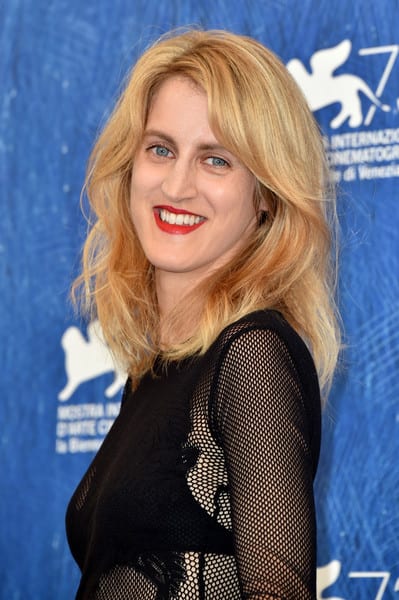
Fien Troch. Courtesy of La Biennale di Venezia!
The theme of youth angst consistently interests independent filmmakers. For example, Andrea Arnold’s American Honey (2016) about vagabond youths selling fake magazine subscriptions in the middle U.S. won the jury prize at Cannes. In We Need to Talk About Kevin by Lynne Ramsay (2003), Tilda Swinton plays the mother of a high school shooter and was nominated for numerous acting awards. The same year Gus Van Sant won the Palme d’Or in Cannes for Elephant, about the Columbine massacre. Three films in the Orizzonti section of the festival this year dealt with these themes : Fien Troch’s Home (Belgium), Tim Sutton’s Dark Night (U.S.), and Gastón Solnicki’s, Kékszakállú (Argentina).
Belgian independent film director Fien Troch won the best director award for Home, a disturbing tale about young people involving incest and subterranean family violence. The story is told in an innovative film style with inventive use of mobile framing (Frank van den Eeden) and solid character development. The enfolding narrative is shown full screen and during flashbacks or special focuses on characters, the screen space is cut in half (film editor Nico Leunen is Troch’s husband). The premise of Home is the paradox of three young men, two of which share the same girlfriend Lina (Lena Suijkerbuijk), all with communication problems at home. John’s (Mistral Guidotti) mother molests her son, Sammy’s (Loïc Bellemans) mother pampers him and teaches him to lie, and Kevin (Sebastian Van Dun) can’t live at home because he fights with his father and his mother doesn’t stand up for him. None of the youths are interested in what their parents have to say, especially John who is told to solve the problem with his mother on his own. In this fresh narrative form, Fien Troche has proven to be a director of high caliber and quality.
Tim Sutton’s Dark Night, based on the 2012 shooting massacre in Aurora, Colorado, builds its momentum in a similar fashion to Home with long takes, sparse dialogue, and recurrent imagery. Cinematographer Hélène Louvart, who worked on Alice Rohrwacher’s The Wonders (2014,)[5] is behind the camera and Jean Applegate is the film editor. The film form is contemplative and provocative. The film chronicles six youths played by Anna Rose Hopkins, Robert Jumper, Karina Macias, Conor A. Murphy, Aaron Purvis, and Rosie Rodriguez. The focus is primarily on male characters doing things that require agency. Young women shop, pose for selfies in their underwear or lie in bed listening to their boyfriend. Young people in this middle-income area spend time in the mall, skateboard, swim, go to the movies, dye their hair orange, Skype, ride around in cars, and fill their universe with “nothing.” Some are equipped with guns, darts, and masks. Male characters (and one woman) express deep-seated rage and one of them takes his town hostage.
Gáston Solnicki’s film Kékszakállú won the FIPRESCI award this year. It’s a magnificently shot epic about the dying Argentine economy that no longer supports the upper class and the young women of a new generation who dispense with its privileges. One of them is forced by her father to work in his factory that produces Styrofoam. Solnicki’s film investigates seven women of “indeterminate state” who are undecided about their futures. Belá Bartok’s short opera Kékszakállú, (recording played in film) is about Bluebeard, an aristocrat and perpetrator of serial uxoricide, who kills his four wives that willingly go to their execution because they are after his money. Solnicki departs from this to show a loosely constructed mosaic of female apathy. The women, played by Laila Maltz, Katia Szechtman, Lara Tarlowski, Natali Maltz, María Soldi, Pedro Trocca, and Denise Groesman, don’t know what they want to do, what to study and have little passionate interest in anything. They cook, try on clothes, daydream, swim in their family’s pool, and try to escape to somewhere else.
The build-up of these three films plays on the passivity and cruelty of young people and their abandonment by parents who don’t understand them or who don’t know anything about them. It is the time of teenage rebellion when parents are taboo and kids go to great lengths in protecting their privacy from their guardians. Without guidance, this makes these young adults volatile time bombs. Dark Night is based on real events, but the realities described in Home and Kékszakállú also cut close to reality. The mesmerizing hold of internal family problems has its expression in violence, apathy, and in worst cases, homicide.
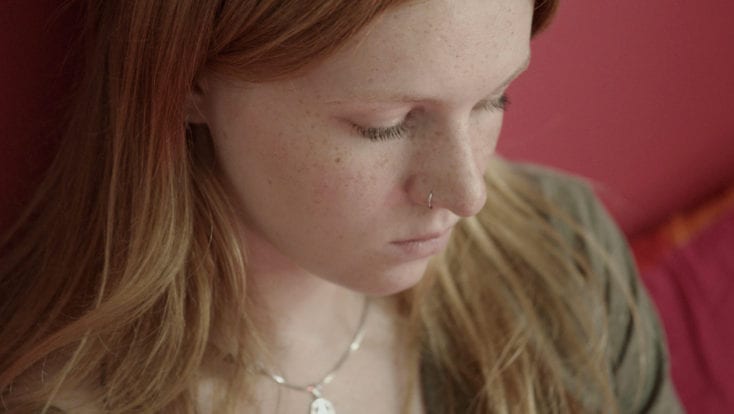
Lena Suijkerbuijk in Home. Courtesy of La Biennale di Venezia.
The real life massacres in Paris, Nice, and Brussels by young alienated outsiders is perhaps the most urgent problem today and it naturally finds expression in cinema. Our War, an Italian U.S. and Kurdish co-production by Bruno Chiaravalloti, Claudio Jampaglia, and Benedetta Argentieri had its world premiere in Venice. It is a unique out-of-competition documentary about three young volunteers from Sweden, the U.S., and Italy who travel to northern Syria to fight against ISIS with the predominantly Kurdish People’s Protection Unit (YPG) in Rojava. Joining the YPG is the YPJ, an all-female brigade of the YPG composed of socialist and non-socialist feminists.
From teenagers to hermits in the mountains, The Eremites (Die Einsiedler—Germany/Austria) is Ronny Trocker’s first feature, a sober portrait of Marianne, who lives on a farm in the Alps with her husband under rustic conditions. Their son Albert (Andreas Lust) visits them often from the village. He works in a quarry and is soon promoted to foreman. An engine-run tram with a metal carriage connects the primitive farmhouse to the village below, but it is always breaking down. Albert has to help carry his old father, who has broken his leg, up the hill. Marianne, played by Austrian actress Ingrid Burkhard (featured in Toni Erdmann in Cannes in May), is a strict, unloving woman with definite ideas that can’t be shaken and a pragmatic view of life and animals. She lost her other sons in an avalanche and the stoic and arduous life in the Alps has set its mark on her so that she seems incapable of warmth and laughter. Living and working conditions are harsh for the inhabitants of this village and its surroundings. Director Ronny Trocker has done a beautiful job on this film with long takes of the Alps, the farmland, animals and the quarry. These are “characters” in the film that almost have a spiritual presence due to the way the set is filmed. As the wind blows through the farmhouse, the shutters and doors move almost as if it is inhabited. The quarry emits vapors like a breathing dragon.
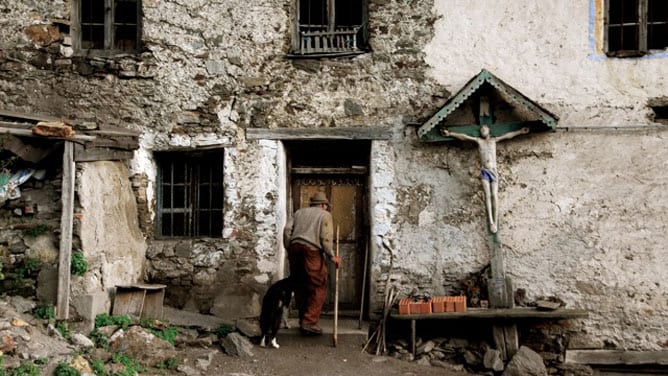
A still from The Eremites. Courtesy of La Biennale di Venezia!
A parallel division that always interests me at the Venice Film Festival is the Biennale College, which features work by young and emerging directors. This year’s films were exceptional. Biennale College, created in 2012, is a laboratory for advanced training dedicated to the production of low-cost films. One of these exceptional films, Una Hermana (One Sister), is Verena Kuri’s (Argentina) and Sofía Brockenshire’s (Canada) first feature. Both have worked on short films together, which have been selected for film festivals. Kuri is a founding member of the production company Nabis Filmgroup[6], dedicated to the production of art house films with a special focus on Latin America. Brockenshire, who studied directing in Buenos Aires, was accepted to the Berlinale Talent Campus Script Station in 2013.
Set in a small Argentinian village accessible by commuter train, Yuri and Brockenshire have made a profound film on the legacy of thousands of missing young women by using the film camera and editing to create ghosts of their disappearances. Their focus is on one woman. Children play on the idle train tracks and hide, setting the ambiance for a grim tale of a young woman’s disappearance. Alba (Sofía Palomino) sets off to pursue her sister Guadalupe’s whereabouts. Nearly everyone she questions seems like they are hiding something. A set of circumstances evolves that point to foul play, such as the family car set on fire. Alba looks in the outlying countryside where her sister is shown in various states of existence meant for the spectator. A young stranger makes his way through this landscape and we are never sure why. The apparitions of Guadalupe are not visible to Alba who senses her presence—she is always so close. These images are cut together with Alba’s visits to the local police who are not very helpful. She questions those who might know Guadalupe’s whereabouts, including people at a local nightclub and her sister’s previous employer and neighbors. The film underlines the fact that grieving relatives and partners are made out to be crazy for their loss through the insensitivity of those not directly affected.
Noteworthy are two films in the Orizzonti section and one from the “Cinema Nel Giardino” (non-competitive) section made by women or about women. A huge and welcome surprise this year was that, Libera Nos (Liberami – “Free Us”) directed by Federica Di Giacomo, won the Orizzonti Award for Best Film. Without any voiceover or film team intrusions, Giacomo documents a dozen Italians who were possessed and cleansed by Palermo priests Padre Cataldo and Padre Carmine in a non-invasive and innovative documentary style. The interactions with individuals who appear under the influence of demonic forces are authentic and disturbing. The priests meet and prioritize those in need, depending on how far they have traveled to see them. The afflicted have what could be called ordinary life problems but their antics are bewildering and frightening. They are shown growling, clawing, writhing, and biting. During church ceremonies they yell and holler. This includes a teenager acting up, a husband who cheats and at the same time wants to collect a debt from a woman who owns him money, and a woman with no passion for life. Padre Cataldo calmly listens to each of his parishioners but comes up with the most provocative and pragmatic comments about their situation. We also see these people “exorcised.”
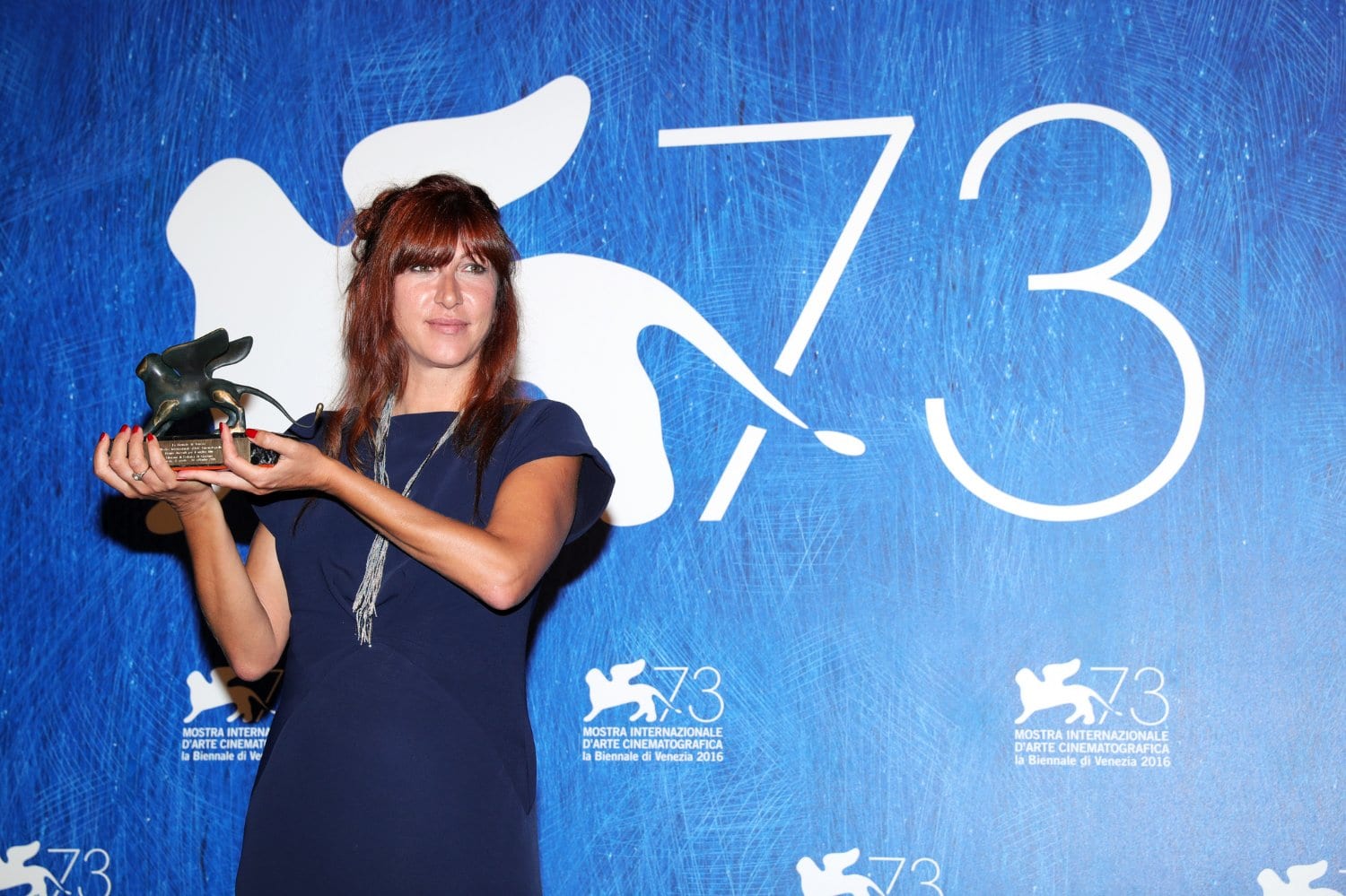
Federica Di Giacomo at the Venice Film Festival. Courtesy of La Biennale di Venezia!
The film ends in Rome where there is a special course for priests who conduct exorcisms held at the educational institute—”Pontifical Athenaeum Regina Apostolorum” in “Auditorium Giovanni Paolo II.” Pope Benedict XVI acknowledged the need for an exorcist in each diocese in Italy during his papacy. According to Le Monde in a postscript to the film (11 Jan 2014), “the French dioceses now have at least one exorcist. In Spain, the Madrid Archdiocese is trying to get 7 more and in Rome and Milano alone, the number of exorcisms has increased from 6 to 12 and the Church has established a call center. In the U.S., the number of exorcisms is 10 times higher today.
Federica Di Giacomo teaches documentary film in Rome and Milano and graduated with a degree in anthropology from the University of Florence. Together with Andrea Osvaldo Sanguigni she wrote the documentary script for Liberami. Greta De Lazzaris and Carlo Sisalli did the photography, and Aline Hervé and Edoardo Morabito served as editors.
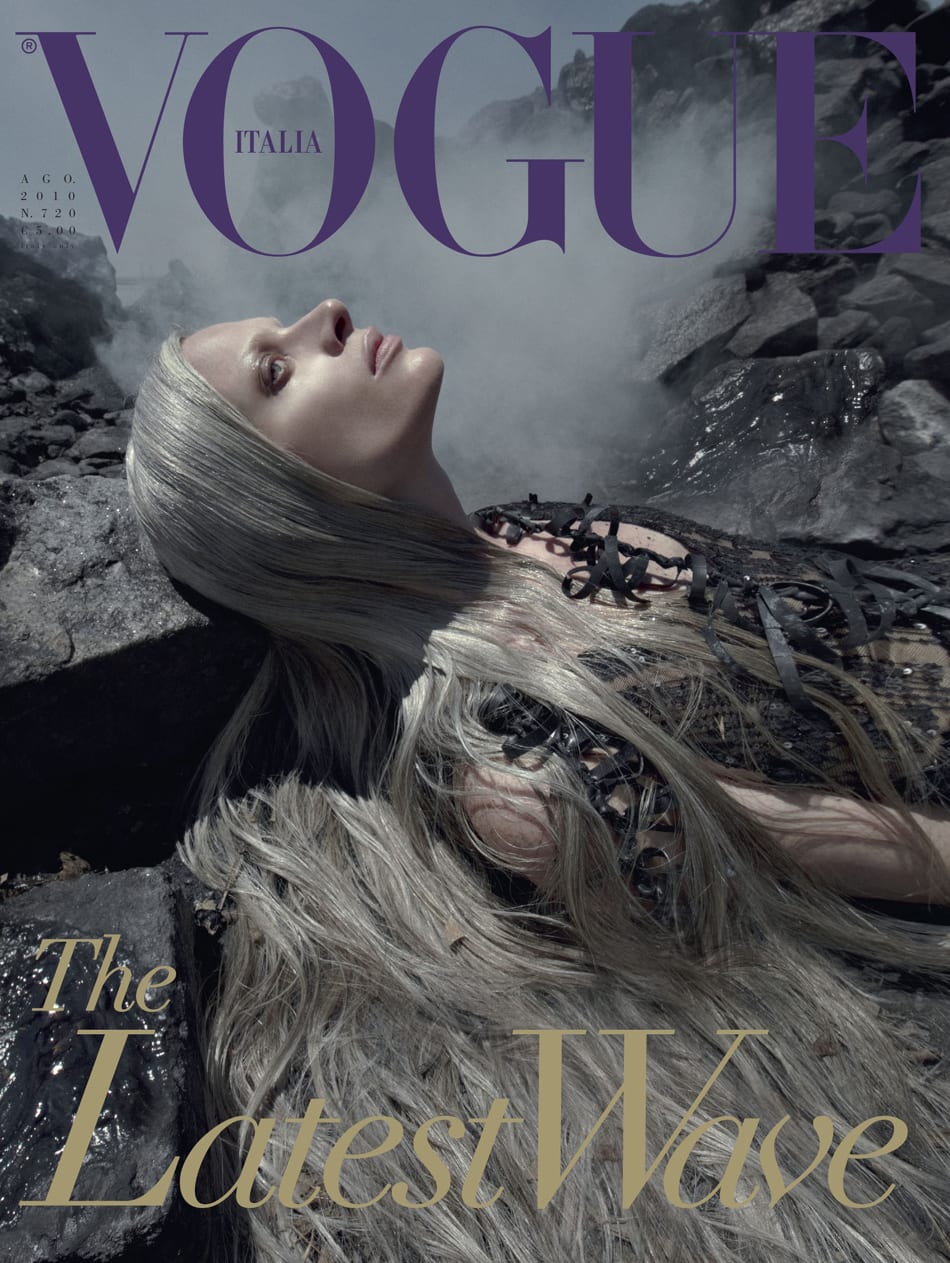
This magazine cover provided by Steven Meisel for Vogue Italia shows the cover of the August issue of Vogue Italia featuring Kristen McMenamy. The issue includes a photo spread shot by Steven Meisel titled “Water & Oil”. (AP Photo/Vogue Italia, Steven Meisel)
A mockumentary titled King of the Belgians by Peter Brosens and Jessica Woodworth (Belgium/ Netherlands/Bulgaria) is an Orizzonti film which takes the spectator on a voyage within politically volatile parts of Europe. King Nicolas III is on a mission to improve his image and assist the integration of Turkey into the EU when his plans run amok.
His majesty and his staff, including a filmmaker engaged to document this mission, find themselves in exile in the Balkans with no airfare and only country roads with rustic travel modes. When the king learns of an uprising in Wallonia in the southern part of his country, he and his staff are forced to escape by hiding out with a Bulgarian singing troupe. The monarchy is threatened and the king and his personal staff find themselves in the heart of eastern Europe, whose complexities are unknown to them. Here Nicolas experiences warmth and friendship for the first time.
Brosens and Woodworth’s films have previously won awards at Venice for Khadak, Venice’s Lion of the Future in 2006, and were part of the Venice Official Competition in 2012 for La Cinquiéme Saison.
In the Cinema nel Giardino section, Francesco Carrozzini’s provocative documentary Franca: Chaos and Creation is about his mother Franca Sozzanni who is going on 28 years as fashion editor of “Vogue Italia.” Franca is renowned for putting women of color in the pages of “Vogue” when no one would. She did a fashion shoot after an oil spill with models covered with oil and evening gowns, as well as young women in school uniforms depicting sexualized violence sprawled over steps with their hair seeping with blood. Sozzanni begins by telling her son she is not an Italian communist, meaning that she doesn’t like the party telling her what to do. But despite criticism, she is insistent that fashion be intertwined with politics in a visual sense. In the first moments of the documentary, indie actress Rosario Dawson turns around while exiting a convenience store to pick up the latest copy of “Vogue Italia” because of its daring bravado.
The Venice Film Festival has an artistic legacy as an outstanding pageant for world cinema. This year’s selection of excellent films with stylized film language was especially innovative. New emerging directors prove that as the world changes, film represents our life events, our political issues, and our need for art and enlightenment. It is important that these needs are articulated through women’s voices beyond niche categories and into the realm of universality. Venice is a showcase that continually inspires the filmmakers of the future, and many of whom will be women.
You can also visit Moira’s profile here.
Notes
[1] Golden Lion “The Circle,” 2000, Venice Film Festival. return
[2]Syndromes and a Century, 2006, first Thai film at Venice and Cannes Palme d’Or recipient for Uncle Boonmee Who Can Recall His Past Lives (2010). return
[3]Sophie Mayer, Political Animals: The New Feminist Cinema, London, New York: IB Tauris & Co, p.6. return
[4] Agnès Varda, Kering Talks, Cannes Film Festival, May 24, 2016. return
[5]Moira Sullivan: Fashion Statements at the 72nd Venice Film Festival: New films by Agnès Varda and Alice Rohrwacher return