Marian Evans
Step 2—The Women’s Gallery
Just before I started work on the picture books, Joanna Margaret Paul, an artist and poet I met through my then-husband, invited me to take part in A Season’s Diaries. I was one of six women to join her in documenting a single month, and I was one of two who were not artists. Joanna wrote—
The idea that one sacrifices other values for art is alien to me, and I think to all women whose calling is to do and be many things.
And in all her work she sought to bring “significant” and “everyday” actions as close together as possible, believing it was natural for women to do this, that our “exercise and training and artistry is in daily living.” Among her experimental films are images of laundry. I love these as examples of bringing together the significant and the everyday.

Her words made me think, and I reflect on them still.
I loved writing and drawing each day, within little frames on a very large sheet of paper, my first time-based work. To have the details of my daily life taken seriously. To see my work on a public wall and know that it reached public walls in other parts of the country. To be among other women who risked exposing their lives. (I remember in particular being affected by a very simple entry from one woman: “Today We Parted. And It Hurt.”)
Later, two of the artists involved and I started a women’s gallery in Wellington. For the first exhibition, we included some of the other diarists, who had already been part of the local women’s art movement in another city.
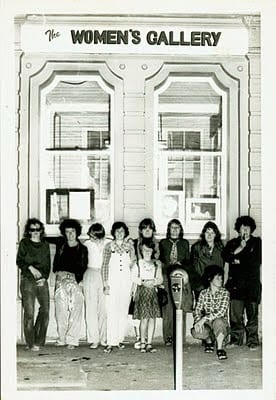
From left to right: Marian Evans, Allie Eagle, Nancy Peterson, Juliet Batten, Anna Keir, Heather McPherson, Bridie Lonie, Keri Hulme. In front: Brigid Eyley, Claudia Pond-Eyley; Photo by Fiona Clark
Some of them looked at and read only women’s work and I emulated them and others, immersing myself in cultural grandmothers and mothers and sisters and cousins. I participated in deep, unrelenting, Bechdel Test-type conversations, as well as conversations about creating and supporting structures that benefited women. For a while I worked full time in a women’s refuge, and the gallery acted as another kind of refuge. I read Tillie Oslen’s Silences about the silences of women writers. I read Joanna Russ’ How To Suppress Women’s Writing. I read Adrienne Rich’s On Lies, Secrets & Silences. I read Audre Lorde’s Sister Outsider. And lots more from women who resisted colonization, assimilation into patriarchies. I learned to ask, always “Who benefits?” The Women’s Gallery lasted four years.
What did I learn? Firstly, the value of counting. We counted how many women artists got reviews and continued the work of older women who’d analysed the gender allocation of state funding in the arts. And circulated our data. It was useful to have facts to support our assertions of discrimination.
I also learned that what I’d experienced with Kidsarus 2 held true within a gallery context. There was a big, untapped audience for work in many mediums by diverse women, including writers and filmmakers, and there were allies who would help us fund our programs. We held lots of theme exhibitions—Self Image; Women & The Environment; Maori Women; Lesbiana; Women & Violence etc., etc.—with associated programs that attracted visitors who normally wouldn’t go to an art gallery.
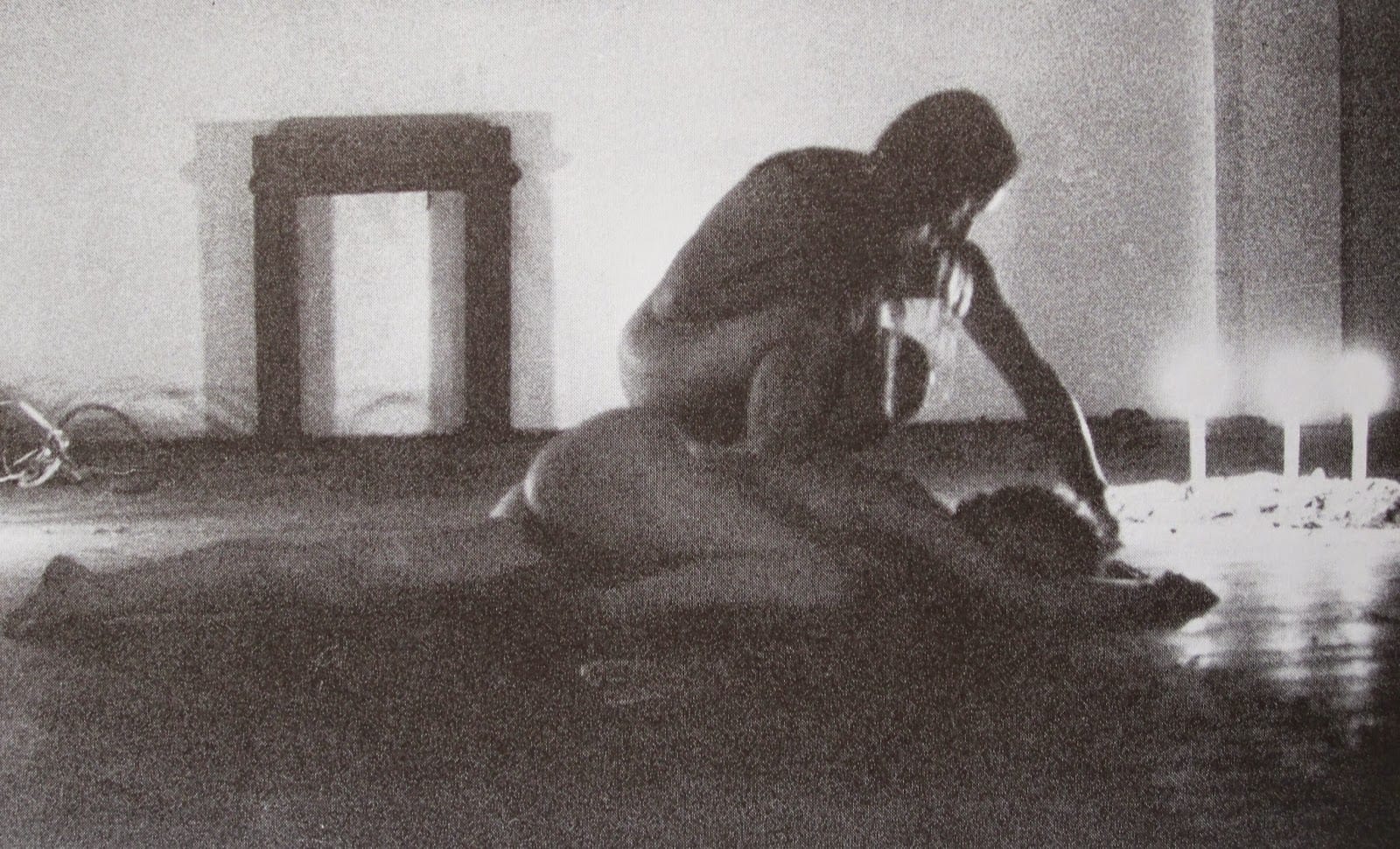
Artists chose to exhibit because they could experiment—sometimes anonymously—with ideas and with work that their dealer galleries thought was inappropriate and/or wouldn’t sell. Women who weren’t artists, like the one in A Season’s Diaries, often made very powerful statements that transcended their sometimes clumsy execution and affected viewers deeply. Even though I never defined myself as an “artist” (for a while I was a “cultural activist”), I felt confident participating in some projects, like this Signs of Life in Aotearoa (New Zealand) performance with Bridie, when I learned I had cervical dysplasia. Working at the gallery was very hard on women who did identify as artists. Though they gave consistent support to other artists and were stimulated by the ideas being articulated, they didn’t have the time to do develop their own practices, which is why some of them enjoyed screen-printing posters, like Anna’s one for Self-Image below.
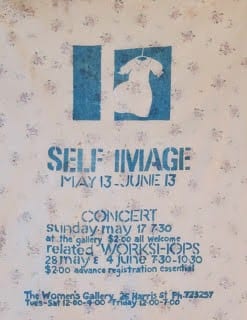
Anna Keir Self Image (1981 silk screen on cotton 58×43.5)
We sold lots of work and were able to influence public institutions when we curated an exhibition (called Mothers, of course!) that toured to public galleries throughout the country, with state funding and often with associated programs, then not common at public galleries. Later, three of us produced A Women’s Picture Book; Twenty-Five Women Artists of Aotearoa New Zealand, where we interviewed some artists and others wrote their own essays. It continues to be used as a text.
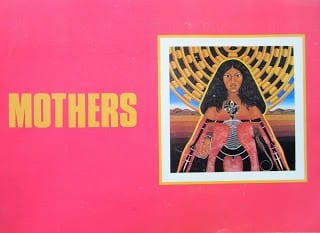
Catalogue cover, with Robyn Kahukiwa’s Hinetitama painting
But not every experiment worked. One of those that didn’t work was Matariki, a women poets tour with Maori and Pakeha (not-Maori) women, working in both Maori and English. Women poets toured only occasionally then, usually as a solitary token among men. The public institutions wouldn’t fund the tour, and we couldn’t work out how else to fund it. And that was when I created a big wall about women poets, from Sappho to the Matariki women, with some mates. “Mates?” you might ask. Yes, they may sound male to an American ear, but “mateship” is a particular kind of Antipodean friendship, among women as well as men. Mates are the friends who are more than friends, sometimes for a short time, sometimes forever. Trusted collaborators, who have your back unconditionally, even if it costs them. They may not even be “friends,” as we usually understand friends. But their solidarity means they’ll help out—climb a scaffold, hold the other end of a banner, come to stand beside you when you’re making a difficult public statement. A “mate” may also express that beautiful, complex, and often subtle Maori concept known as “tautoko.” Giving tautoko can mean that in a public forum one human being stands alongside another while she struggles within a challenging situation. She offers support for someone in pain, even when she disagrees with the views the other is expressing. I’ve experienced this kind of tautoko from time to time, once from someone I’d never met before. It’s an extraordinary gift, when someone arrives at your side and provides their silent physical presence to support your voice.
Back then, in the 1980s, so many women poets had “flown up against a patriarchal wall and been bruised or broken.” We needed mates. There’s less bruise-and-break now for New Zealand women writers. But not for our script writers and directors.
![Matariki Wall (detail) [trans: 'na koutou i tangi na tatou' – 'when you sang/wept, we all sang/wept']](http://agnesfilms.com/wp-content/uploads/2014/11/but-not-for-our-filmmakers.jpg)
Matariki Wall (detail) [trans: ‘na koutou i tangi na tatou’ – ‘when you sang/wept, we all sang/wept’]
Years later, I looked again at a video from The Women’s Gallery of Nancy Peterson interviewing another founder and co-ordinator, Anna Keir, and me (in the shades!). I watched myself say things similar to what I say now. I watched myself change places with Nancy and run the camera and the interview. I can see that I wanted to be a filmmaker. Filmed just a few months before I came out as a lesbian, this clip has special poignancy for me when I watch us discuss the support my then-husband, an artist, was giving us, alongside women who just didn’t want men around.
Raw footage, produced by Auckland Community Women’s Video Inc camera: Nancy Peterson
It would be a long time before I was behind a camera again. The personal stuff and the activism meant I took many years to commit to my own work as an artist and writer.
Step 3—The Spiral Collective
Heather McPherson, a poet who’d taken part in A Season’s Diaries, had earlier founded Spiral, New Zealand’s only ever women’s arts and literary magazine. Frustrated by the men poets’ exclusion of women poets from public readings and intensely focused on what is sometimes called “cultural” feminism, she and the collectives she led produced four issues of the magazine. But her own collection, A Figurehead: A Face, was unpublished. Anna and I offered to publish it using the Spiral imprint, and did so from the Women’s Gallery, using what we’d learned from Kidsarus 2 and the gallery, particularly in relation to marketing.
The first New Zealand book of poems by an out lesbian, A Figurehead: A Face sold quickly, even though the printing job was shoddy and we didn’t know how to insist on better work. That achievement encouraged us to publish a book of short stories by Jacquie Sturm, widow of one of New Zealand’s literary golden boys, whose manuscript had been sitting under her bed for decades until she read some stories from it at the gallery one evening. Jacquie was one of the earliest Maori to publish short stories in magazines, starting in the 1950s. Her book, The House of The Talking Cat, also sold out.
Already acting as confident publishers-of-last-resort, and building on the Kidsarus 2 skills and experiences, it wasn’t hard to decide to publish the bone people for Keri. It went on to win the Booker Prize, and I’ve written about that process in detail here.
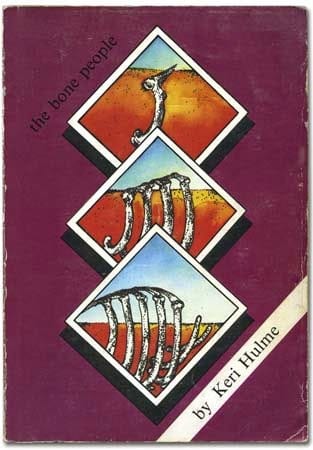
The original the bone people cover, illustrated by Keri Hulme herself
The main lessons from the Spiral Collective time were that I became deeply familiar with the nitty gritty of publishing and marketing, more practiced in welcoming the unexpected (people we imagined would be delighted to help often didn’t help, but some surprising people did), and my recognition that I didn’t enjoy public success. I wasn’t the writer of any of the Spiral books or an artist in Mothers. But I was associated with the projects’ success through being a publisher and a curator. For a while, too many people were “after me” and I hated it. (And falling in love with me, which could also be problematic.)
Paradoxically, although many other feminists entered “the system” around this time and became successful business owners and government employees, I didn’t know what I wanted to do and didn’t want to be assimilated. And I couldn’t get a job, anyway. Friends suggested that like other feminists I go into politics. Or into policy-making, to make change from within. But I retreated into single motherhood, now with three children. Fortunately, Heather McPherson asked me, “What will you regret not doing, later?” And I realized that I wanted to finish my law degree.
Step 4—The Law
Way back, when I was pregnant with my second child, we lived in the country, an hour away from the university. Most of my degree in New Zealand History was complete, and I was doing some law papers. I’d take the railcar that arrived in town at 8:45 a.m. and would walk along to the university, stopping beside the same tree each day to throw up, if I hadn’t done so already on the railcar or at the station. And sometimes if I had. Of course I failed my courses.
So, after the intensities of the Women’s Gallery and the bone people ended, with no paid employment in view, it made sense to come out of retreat to finish the law degree. With difficulty. I hated some of the bullies who taught us using a bastardized Socratic method. I loved at least one lecturer, who embodied the best of Socrates. The theater of law did fascinate me. I was very happy the day I passed my professionals. (Even happier later, when I worked my way through a masters and gained it with Distinction.)
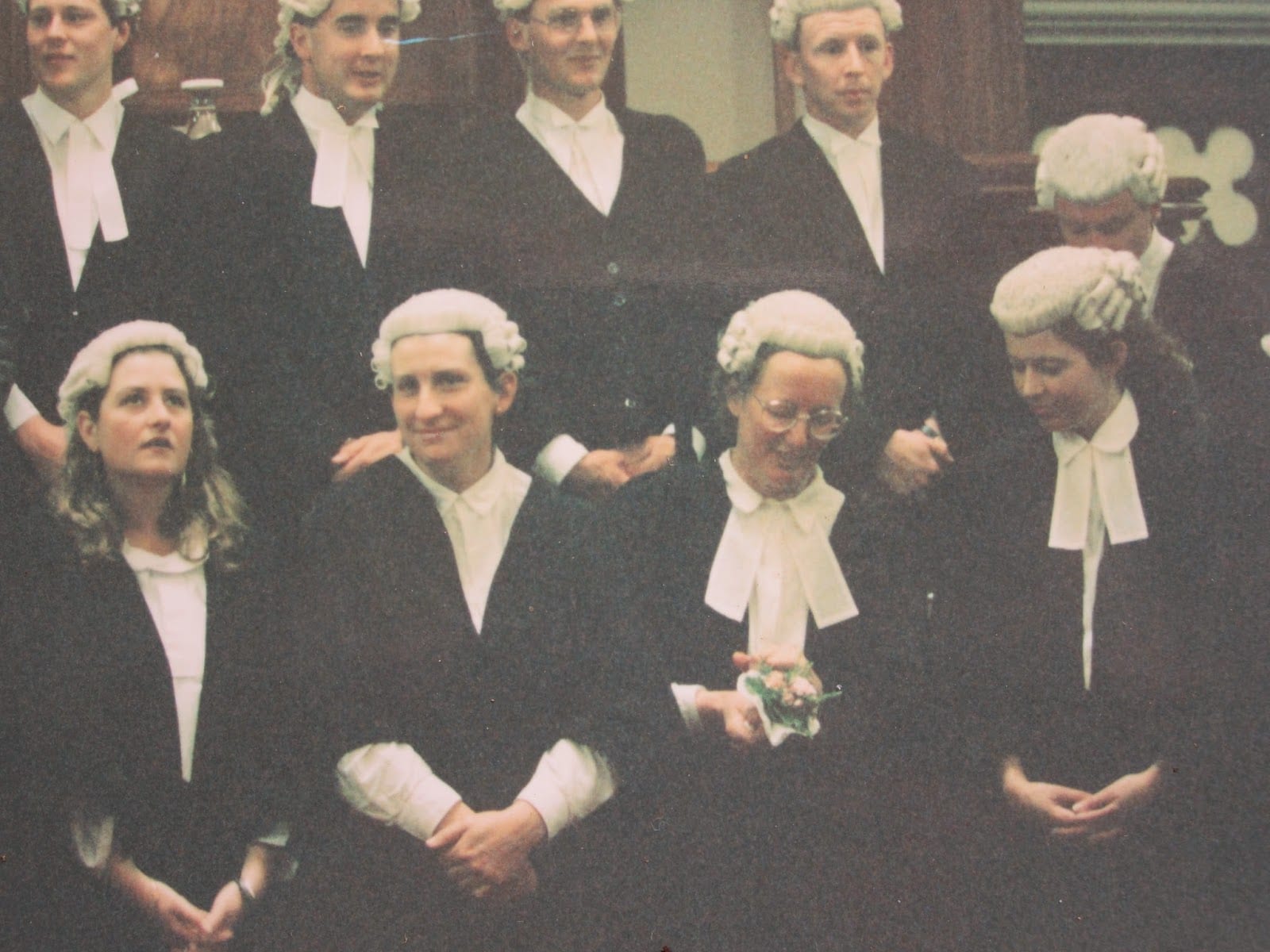
The day Marian was admitted to the bar
But again, I couldn’t get a job. Partly because I was distracted. In one interview, I couldn’t even remember the name of my favorite law lecturer. With others from Spiral, I was about to leave, to take New Zealand women’s books to a women’s book festival in Europe, where we’d twice managed to sell rights to various women’s fiction that had never before been published outside New Zealand.
But I worked for a while as a self-employed barrister, and with another feminist lawyer wrote about my experiences, again in a diary form, and about the law’s structural inadequacies for dealing with women who had been abused. That work became used as a law school text.
When I looked for images for this section, I found a clipping from this time, which I’d forgotten.
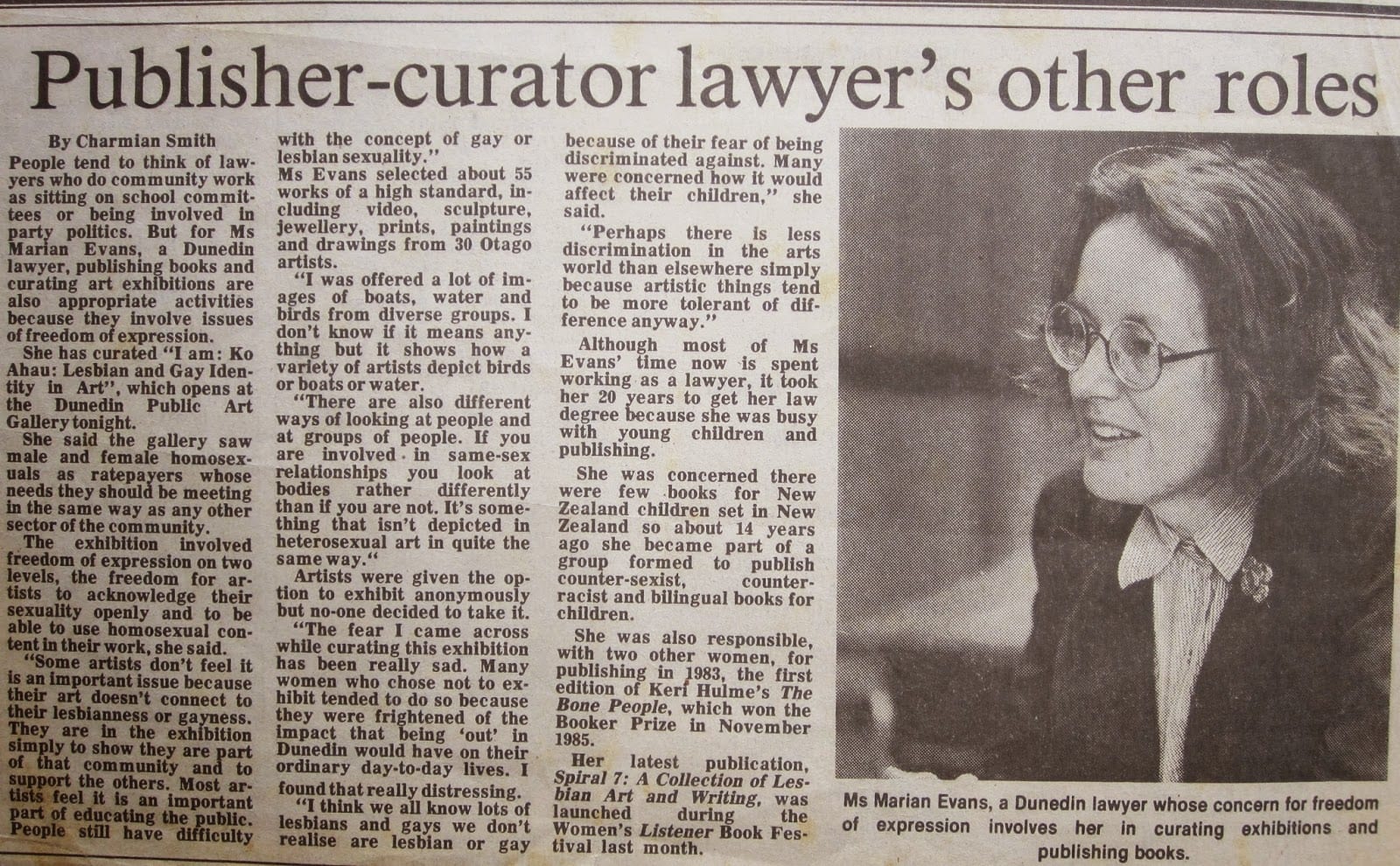
There I was, twenty years ago, curating New Zealand’s first gay and lesbian exhibition in a public gallery, editing a lesbian edition of Spiral (that women’s art and literature journal founded by Heather McPherson) and talking about it all. Back then, in that city, there was no out lesbian and gay lawyer. As I state in the article, there were also artists who feared being out. In that context, no wonder I struggled to find an employer.