Interview with Leah Meyerhoff, Writer and Director of I Believe in Unicorns
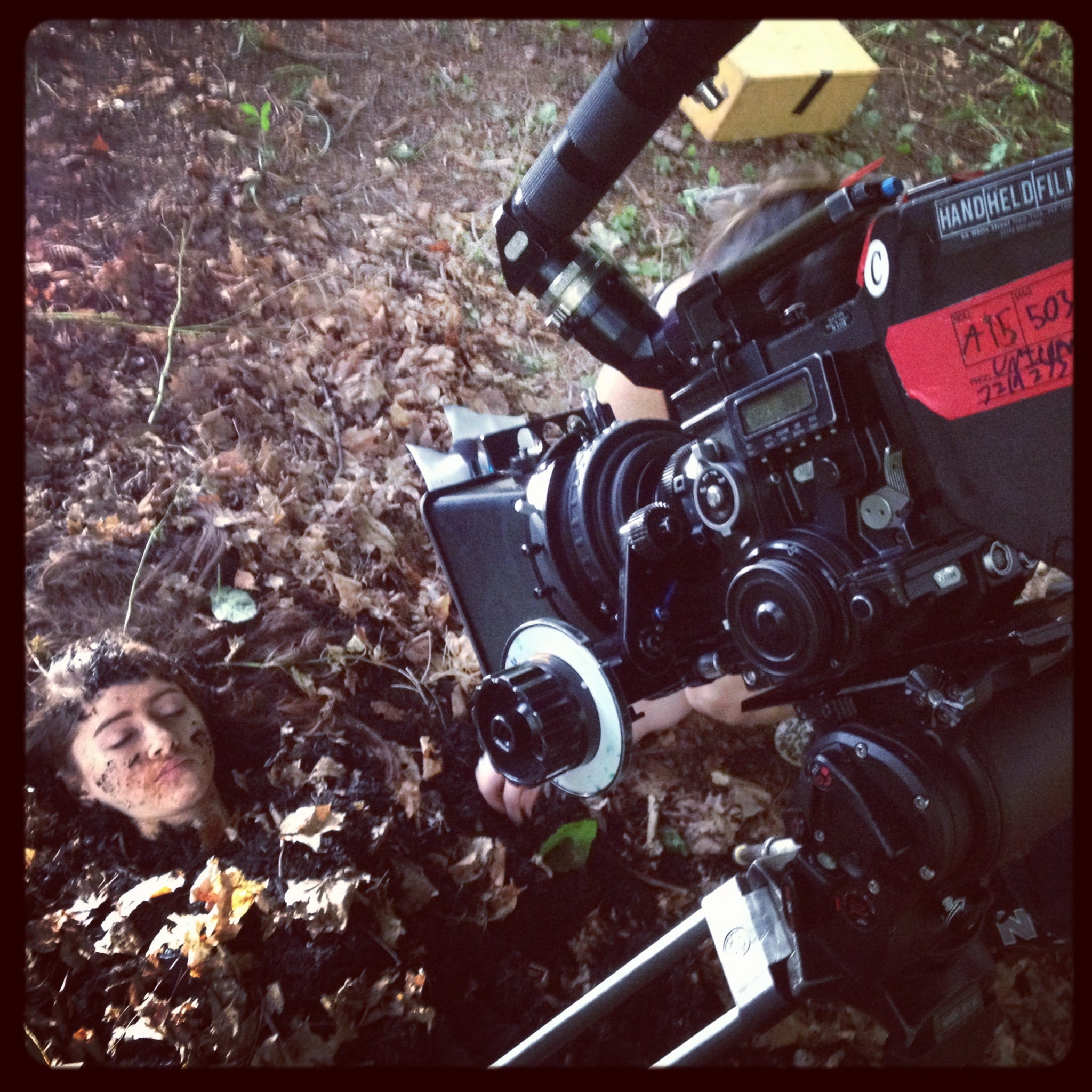
“On earth day we buried the actress up to her neck.”
From what I know of your process, it actually mirrors and has a push/pull relationship with Davina’s story. The fact that you shot on film but edited and finished digitally, you had a unique opportunity in the specific window of time you were working to do so. You even got most of your film stock donated?
The timing was just fortuitous, in that our entire camera package was donated because not a lot of people were shooting in super-16 at that time and our film stock was almost entirely donated as well — Fuji was discontinuing the stock we were using. In terms of cost-effectiveness, we really only paid for the processing, which came out to be cheaper than what most productions pay to rent a digital camera package. Because we were shooting on film, working with a lower budget and film is a finite resource, we had only so much donated — it made me as a director much more decisive about what I wanted to capture. We didn’t do a lot of takes, we didn’t have a lot of coverage we were very specific in what we needed. With the animation everything was storyboarded and was planned out, yet we still allowed ourselves some fluidity in the way of working.
We had three weeks shooting live action in San Francisco with actors like a regular film shoot. Then I went back to New York and started editing, and as we were putting together a rough assembly and started the animation which took several months … I received an additional grant from the Tribeca Film Institute that allowed us to film four days of pick-ups. We used those days to do the extensive visual experiments that ended up in the film. We went to this yoga farm in upstate New York and each of those days had a different theme: fire, earth, air, and water — the four elements. So each day I would tell the crew, “Today is fire day — bring your fire, let’s see what you got.” We did the fireworks scene and did a lot of time lapse. Another scene was stars in the sky and time lapse of the clouds in sunset with a red hue. On earth day we buried the actress up to her neck and animated these vines crawling around her face. So we really came up with a visual improvisational way of working, and some of that material is my favorite visuals in the film that hadn’t been scripted. We bought some expired film stock off E-Bay, scratched up the negative, and really tried all kinds of things which really ended up coming out quite beautiful.
You are from the Bay Area and certain elements of location, as well as loose biographical details, are very important in this film. You also cast your mother, which speaks to your vested interest in various types of representation on screen.
In the same way that I wanted the lead female character to feel authentic and real, I wanted to take that approach with all of the characters. The most personal and biographical aspect of I Believe in Unicorns is that the mother is based on my mother in real life and is played by my mother. I grew up in somewhat unusual circumstances in that my mother has multiple sclerosis, was diagnosed shortly before I was born, and has been in a wheelchair for almost as long as I can remember. So from the age of seven into my teenage years, I was the sole caretaker in the home. As I was writing the script I naturally drew upon memories from my own time as a teenage girl, and that backstory and mother character worked its way into it, which led me to cast her in the film itself. In the same way that I wanted a teenage girl to play a teenage character, I couldn’t imagine casting an able-bodied actor to play a disabled character. I realized that is what happens all the time. I can’t think of another film outside of documentary in which I’ve seen a disabled actor on screen. It was an unusual casting decision, but one that I’m very happy with and confident in. I think my mother brought a sense of authenticity to the role and to the physicality of the character. There is something that happens to your body when you can’t use your legs for decades — they become heavy and filled with blood. There is a certain way of moving and relating to the world that is difficult for an actor to fake. She did a wonderful job and gave a great performance in the same way that our lead teenage actress did.
That decision to cast my mother in the role necessitated us filming in her home, which is in Oakland. The entire film was shot in the Bay Area, which had the added benefit of allowing me to film in real world locations that I remember growing up, like Berkeley High School, Indian Rock, and one of the punk clubs that I used to hang out at, which was really a nice way of grounding the story in place and also involving the local community in the production.
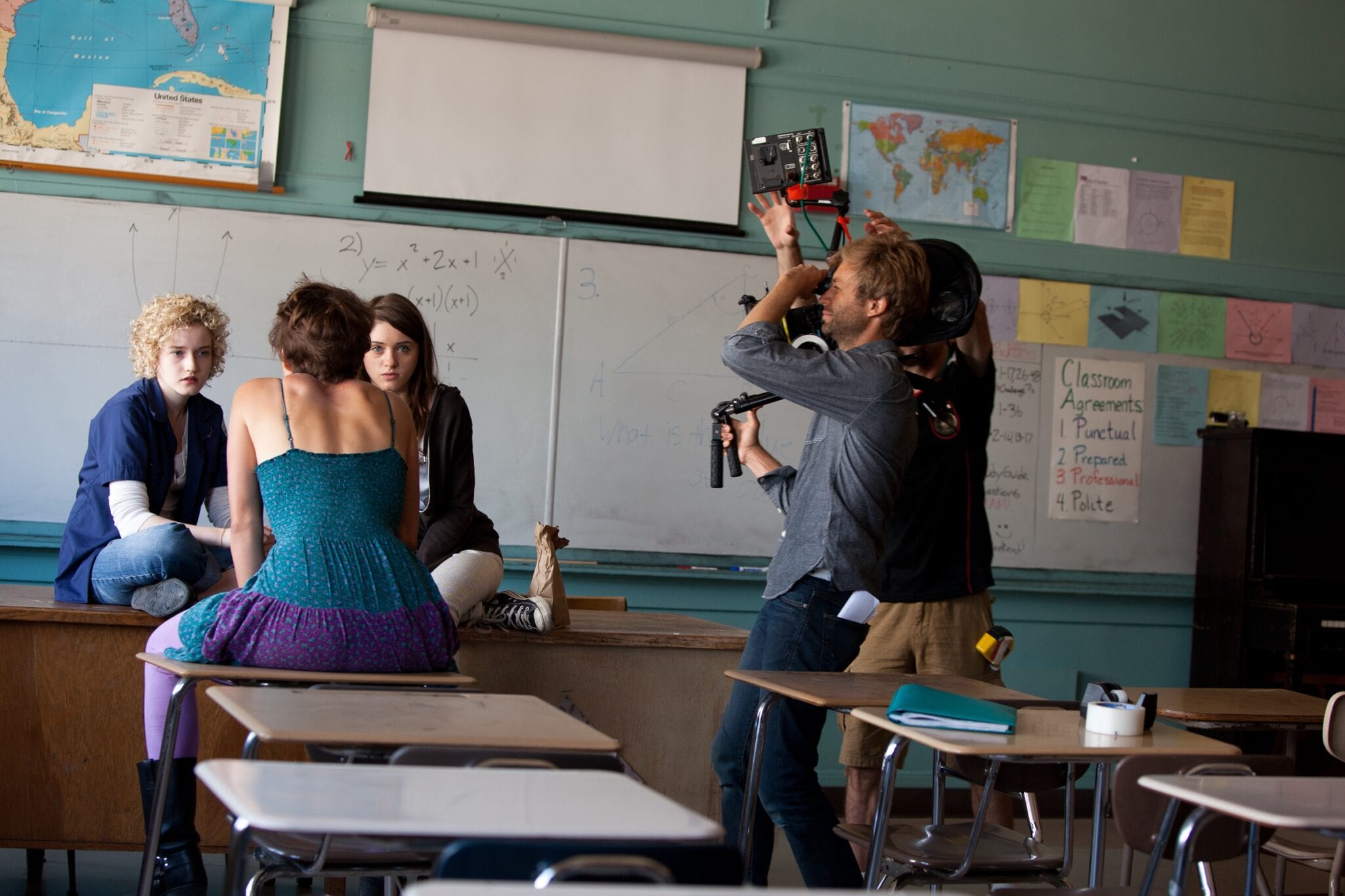
On the set of Unicorns
Your distribution strategy and release methodology might not appear to be that different for people who are keeping up with the changing tides in the film industry. However, I find it interesting that you fully involve Film Fatales and its many chapters to help support and spread the word about screenings: you didn’t have a day and date release or release windows. Instead it was across the board, so that you could reach all kinds of different audiences in the way they are expecting to be catered to. Beyond this you are also doing something — for lack of a better analogy — that brings a real film festival experience to the audience. Each night you have a moderated discussion with a different theme.
We are taking a hybrid approach to distribution and incorporating event-based distribution. This film premiered at South By Southwest in 2014, and we’re working with Gravitas Ventures as a distributor, but I traveled the film festival for a full year around the world in preparation for the theatrical release and that allowed me to reach an audience that I otherwise would have had difficulty reaching. I was able to show this film in Melbourne, Australia, and Edinburgh, Scotland, Croatia, Munich, and Jerusalem, as well as smaller towns across America [that] otherwise wouldn’t have had the opportunity to see the film in a theater — I knew we were never going to get a 100-screen multiplex theatrical release. So I used the film circuit as a tool for outreach in reaching a diverse audience around the world, as well as a way to build the community of Film Fatales in an amoeba-like way, city by city, almost like Fight Club. It has also tapped into local communities. I would go into colleges and high schools in whatever city I was at during a film festival and do additional screenings for students, which goes back to one of the main reasons I made this film and wanted to become a filmmaker: to create more representation of young women on screen.
The most rewarding and gratifying audiences for me personally as a director is when I look out into the crowd and it’s full of young women and men who are so appreciative of this film and haven’t seen anything like it. It gives me great pleasure to expose an audience of young viewers to art cinema and films with female protagonists. We have also released the film online on iTunes, Amazon, Vimeo, and other platforms in conjunction with a theatrical release, which we’ve been rolling out over time so that I can personally attend as many screenings as possible and do Q&As with different filmmakers every night. The way that Film Fatales and Unicorns has aligned is in each city where the film is released theatrically, we’ve organized nightly screenings and discussions with other female filmmakers from the community with different discussion topics and different moderators every night, which is really taking the film festival format and applying it to a theatrical release. It’s been a wonderful way of not only supporting the film and expanding the audience but also for building community and raising visibility of Film Fatales and other female directors while building a community of people who support independent films and seeing them in theaters. We’ve had people come several nights in a row to see the film just so they can participate in the various discussions afterwards. In New York, we had conversations with Mary Harron who directed American Psycho, I Shot Andy Warhol, and The Notorious Bettie Page; Bette Gordon with Variety; Debra Granik with Winter’s Bone, and her new film Stray Dog. In Los Angeles, Marielle Heller with Diary of a Teenage Girl, which is going to be released in August 2015, as well as Jen McGowan, whose film Kelly and Cal just came out, and so we really are using the theatrical release of Unicorns to also promote the films of other women in the group and support each other in that way. We’ve had male filmmakers on these panels as well. For example, Frazer Bradshaw, who was a second-unit cinematographer for Unicorns, is also a director and cinematographer in his own right.
It’s been a fantastic experience and also keeps me inspired and keeps me going because distributing a film can be less creative and more draining than the production of a film. But by creating this community and event-based system of distribution it makes it exciting, new, and different every single night. I’ll also say the theatrical release reaches a certain audience, and reaching out to high schools and colleges reaches a different audience, and our online push reaches a younger audience. I knew that I was going to have a young teenage lead and that I wanted young women to see the film and that it would be difficult to find it in a theater near them. I know a lot of younger people don’t go to theaters anymore, and they don’t go to festivals — they download stuff online. So we knew that a social media push, even before the film went into production to do outreach to bloggers, organizations, and individual kids, [would be important] — we now have almost 200,000 likes on our Facebook page that are really enthusiastic supporters of the film and are fantastic community builders in their own right. So when I have a screening anywhere, I can post on our Facebook page “I’ll be coming to town for five days” and all of the local young people in that town will spread the word, put up posters. And going back to the Riot Grrrl analogy, it’s like touring with a band — I feel like I’m connecting with my fans in a really collaborative way. It’s a back and forth, a give and take. I’m often learning as much from them as they are from me. Having these event-based screenings where I can meet the audience afterwards has really been a fantastic ride.
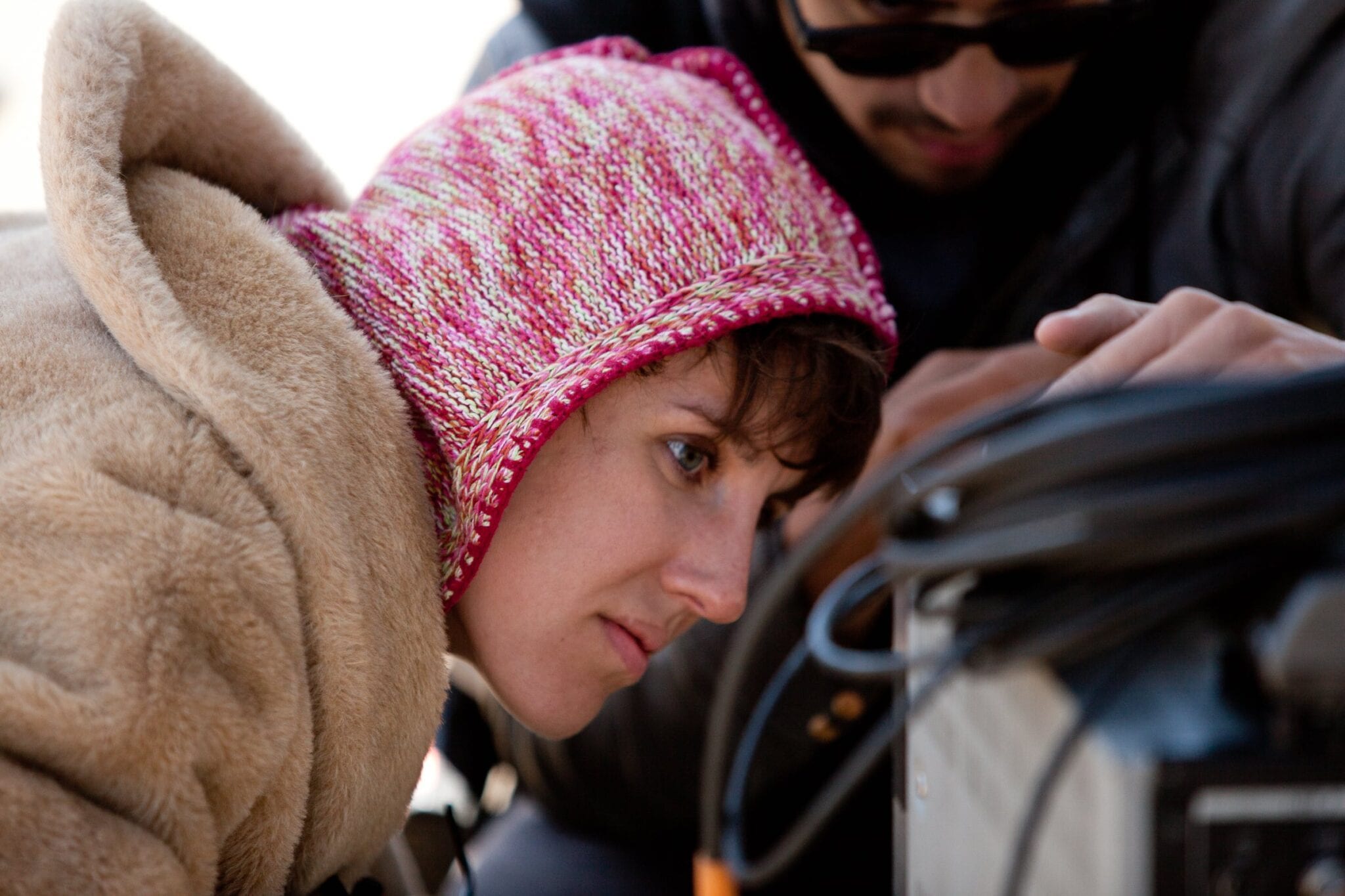
Meyerhoff directing Unicorns
I’m curious to ask you about a perspective on female filmmakers in light of someone like Agnès Varda, who would refer to the term as ghettoizing and entwine it with someone like Rose McGowan, whose new short film Dawn has been released free online as an extension of her commentary on the treatment of women in the industry. On one hand, it may be a matter of an older generation that had to fight tooth and nail to get to the final phase of completing a film and releasing it as a female director; on the other hand we have a younger generation in their 30s and 40s who have seen the rise and fall of American independent film. The release of McGowan’s film seems a politicized statement, especially with larger questions of women hitting the glass ceiling in the industry and having limited opportunities. At the end of the day, do women actually want to work in an industry that is historically gender biased?
That is such a meaty question. Personally, from my transition to making a feature over the past five years or so, there is a certain faction of women directors who don’t want to be identified as “women directors,” who want to be identified solely as directors. I respectfully disagree with that way of identifying, but it is one that I used to share. As I was starting out in film school, almost half my class was women; it didn’t feel like I was at a disadvantage for being a female director when I first began this path. It wasn’t until I got through film school and realized, “Oh, there are no female faculty members in this program” and “I’m at a film festival and there are no other female directors here.” Then I started to see the institutionalized gender bias firsthand. It really wasn’t until these past few years with all these studies coming out, looking at the statistics and realizing just how engrained gender bias is in our industry — in Hollywood and the independent world, obviously much more so in Hollywood. There are studies that show there is less than 5% — I think closer to 2% — of the top grossing films in the last few years were directed by women. In the independent world it’s less than 15% of narrative feature films. There is nowhere near an equal representation behind the camera, nor in front of it.
One of the most interesting studies has come out from the Geena Davis Institute on Gender in Media in which they analyzed hundreds of films and noticed that less than 30% of the characters on screen with dialogue were women. So, if the films we’re watching don’t even have a 50% representation of women on screen, it trickles down into all corners of our society. Women aren’t being shown that their stories are worth telling. And for all of these reasons, I have come to identify very strongly as a female director and find strength and empowerment in that, especially in conjunction with a community like Film Fatales, in which I don’t feel like I’m doing it alone. I feel like there are hundreds of us who are here, and we need the same access to opportunities and specifically to the same amount of financing that our male counterparts have access to. At the same time I respect the opinion of women like Agnès Varda and possibly Bette Gordon and these generations of female filmmakers who came before who had to really fight to get there — like Kathryn Bigelow. I would assume that they, in fighting to get their voices heard, learned to be one of the boys and play in the boy’s club — for lack of a better way to describe it. And now that they are there, [they] feel like it is a step backward to identify as a female director because it can be ghettoizing, when women should be able to make all types of films — not just “women’s films.”
There is this misconception, particularly in Hollywood, that a film that has five straight white male characters is just the next comic book super hero movie and a film with five female characters is all of a sudden a chick flick and only a female audience will see that film. Therefore films about women are harder to finance, that they have a limited audience because men won’t go to see films with female lead characters. And that is this pervasive belief, which I think is misguided — at least in my own experience making I Believe in Unicorns. Anecdotally, I have come across a huge audience that is hungry for more stories about female characters and found an audience that wants a diversity of characters onscreen. I think part of that process will be to have a diversity of directors, writers, and producers as well. Women and people of color statistically are more likely to tell stories and make films that have more complex female and minority protagonists than straight white men are. I think that’s just human nature. Often those voices that have historically been disenfranchised and shut out of the system are more passionate about telling our stories and changing that ratio of what we see on screen.
I wanted to ask you my three James Lipton questions. I’ll give you the beginning of the sentence and I’d like for you to complete it as you see fit, with the first thought that comes to you.
Seeing I Believe in Unicorns with an audience for the first time was . . .
incredibly overwhelming and rewarding. It reminded me of why I made this film in the first place. The first time I saw this film with a large audience was at South by Southwest a year ago. It was a primarily younger audience that was so enthusiastic and so appreciative of the film that it really energized me and made me want to go make another film right away.
Making a film is . . .
one of the most difficult, challenging, and also amazingly gratifying and fantastic things that one can do. I think filmmaking is a tool for empathy. It is a way to communicate with other humans in our culture about characters and stories they may not have been exposed to – which is why of all the art forms I’m most drawn to cinema because film allows us — for that brief moment of time, that hour and a half in a dark theater — to watch another person’s story unfold from their perspective. In doing so, it expands our own definition of humanity and creates empathy for other points of view. In my case — by making I Believe in Unicorns — telling the story of this imaginative and different teenage girl I hope to take the audience on a journey and will watch it from her point of view and understand a bit more about themselves and about the world. I think cinema is the most exciting language to communicate on a mass scale with other people.
I Believe in Unicorns is . . .
a magical-realist, emotionally complex journey of a young woman as she navigates the complexities and ambiguities inherent in growing up and figuring out who she is in the world.
Check out I Believe in Unicorns coming to a theater near you, on iTunes, Amazon and Vimeo.
Click here to view Denah’s profile.